
The EN 13155 is a European minimum standard. This standard applies to vacuum lifters in general and covers a wide range of loads, such as concrete, steel, and glass. It defines the requirements for manufacturing a CE-certified vacuum lifter.
However, on the work floor or construction site, you—as the user—are always responsible for carrying out a risk assessment to prevent people from being struck by a falling load (in accordance with Health and Safety regulations).
Every situation is different. Not all specifications for building a vacuum lifter can be fully defined within a single standard. That is why it is essential not only to select the right lifting equipment, but also to implement the appropriate safety measures based on:
- The specific situation (risk assessment)
- The load being lifted (glass)
We manufacture vacuum lifters specifically for glass. Because glass can break or slip, it is widely recognized that additional safety measures beyond the EN 13155 standard are required.
To provide clarity, we have developed a simple 1-, 2-, and 3-star system. This system clearly indicates in which situations each vacuum lifter can be used most safely and effectively.
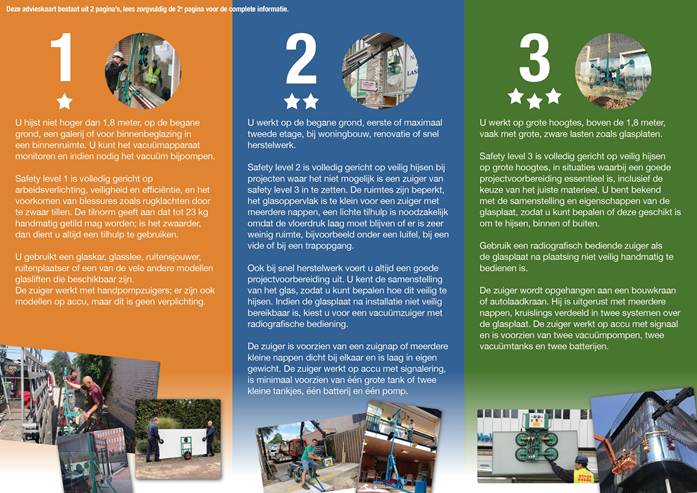
In addition, practical tools are available to support your risk assessment process, such as the Safety Ladder.
Every Step Counts – Do Not Skip a Single One!
1. Proper planning and preparation
Identify the risks and implement the appropriate control measures. For high-rise projects and public spaces/areas, always choose a 3★ Excellent device.
2. Proper maintenance
Have the equipment inspected by the supplier at least once a year. Always check the inspection sticker.
3. Pre-use inspection
Ensure the battery is fully charged, clean the rubber suction pads, and check the inspection sticker.
4. Never lift in rain, frost, or strong winds
5. Clear the lifting area
No one must be beneath the load during lifting operations. Clearly cordon off the area and ensure it is properly supervised throughout the lift.
6. Fall protection is mandatory
When working at heights above 1.8 metres, fall protection is required. Take extra care on high-rise projects, in public buildings, and where there is a long crane lifting distance. The use of a dual vacuum system does not exempt you from this rule.
7. Always remain within sight and hearing distance of the vacuum lifter.
8. Use hand suction cups and PPE
Installing a glass panel is precision work. Most personal injuries occur at this stage, due to trapped fingers, or glass falling onto limbs after the panel is accidentally knocked or damaged.
Use hand suction cups as grips to guide the glass safely. Protect yourself with appropriate PPE and always remain outside the potential fall zone.
In the following article, we explain the different construction methods of vacuum lifters currently available on the market. All of these designs comply with EN 13155. However, we manufacture exclusively according to construction types 1 and 5.
The other construction methods (types 2 to 4) operate at the limits of what the standard technically allows. While they may formally comply with EN 13155, they can create a false sense of security. For this reason, we choose not to build them.
When safety matters, compliance alone is not enough—true safety requires conscious design choices.
Schematic layout of a vacuum lifting device for glass lifting.
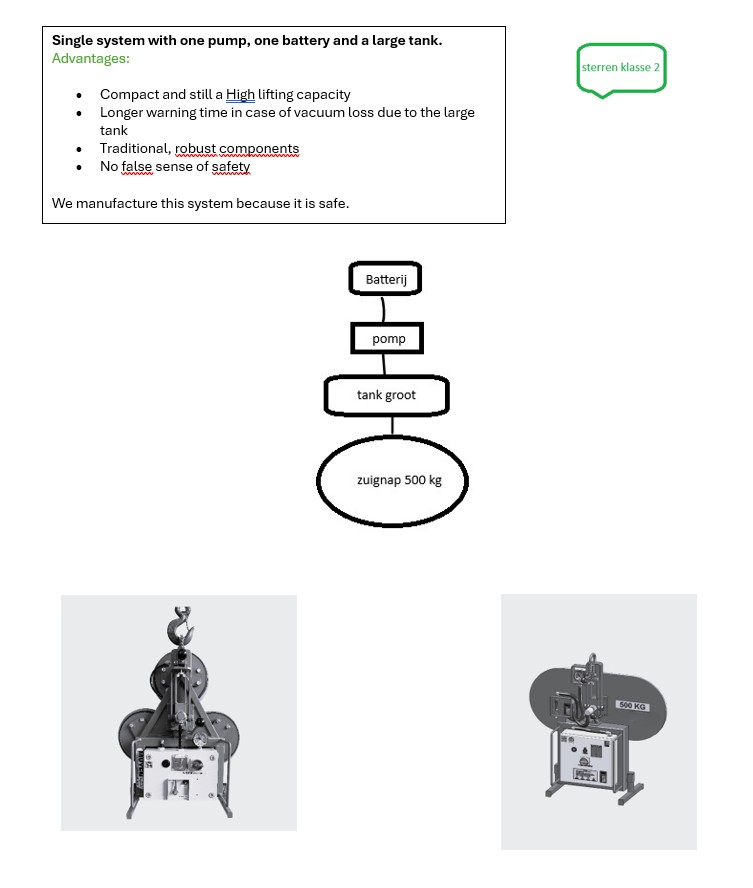
Clearing the area and the use of fall protection during crane operation are always mandatory when you install glass for every model vacuum lifter.
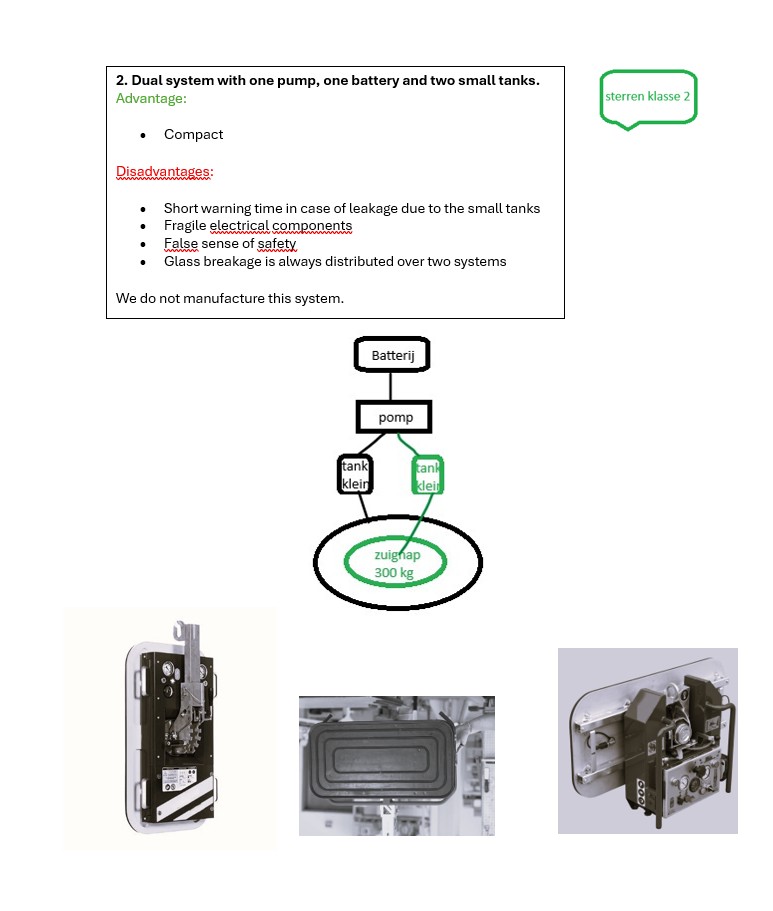
Clearing the area and the use of fall protection during crane operation are always mandatory when you install glass for every model vacuum lifter.
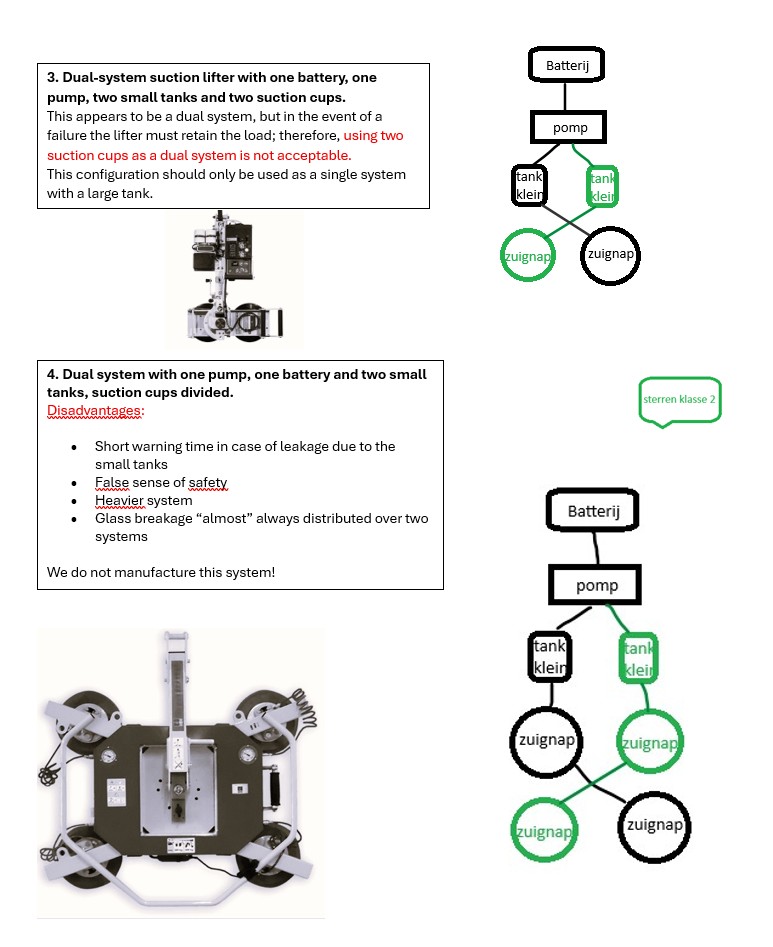
Clearing the area and the use of fall protection during crane operation are always mandatory when you install glass for every model vacuum lifter.
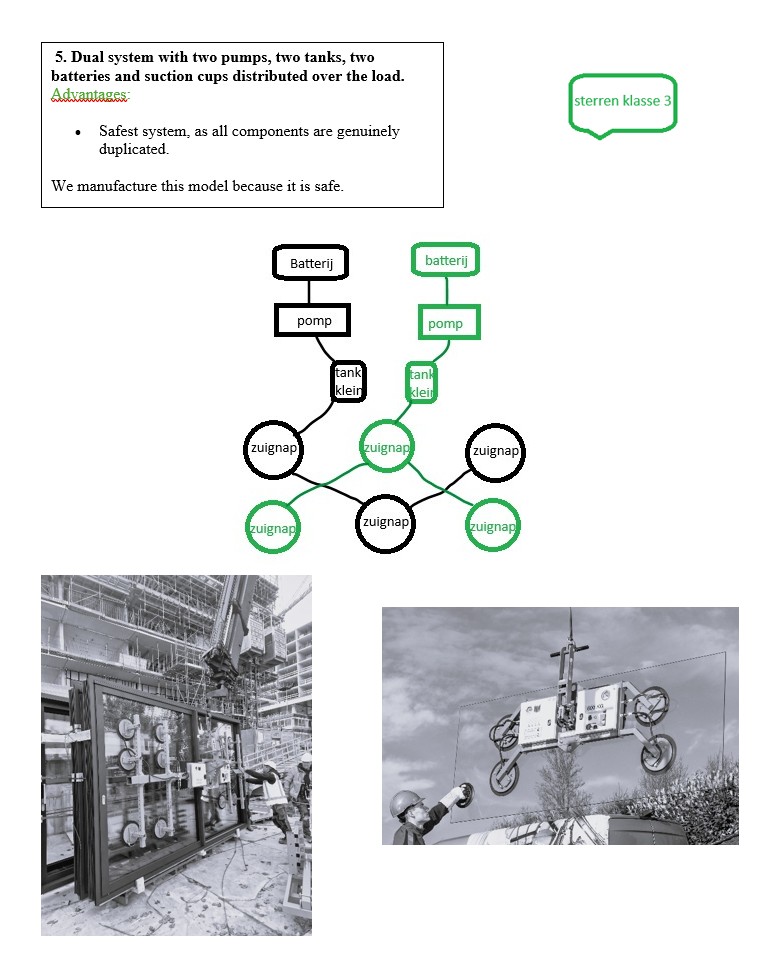
Clearing the area and the use of fall protection during crane operation are always mandatory when you install glass for every model vacuum lifter.
- We only build systems according to No. 1 and No. 5, as these are safe and eliminate the risk of false safety.
- All models listed from 1 to 5 are manufactured in accordance with NEN 13155, with the exception of Model No. 3.
- When working at greater heights, the use of a radio remote control is recommended.
- Clearing the area and the use of fall protection during crane operation are always mandatory, for every suction lifter model.
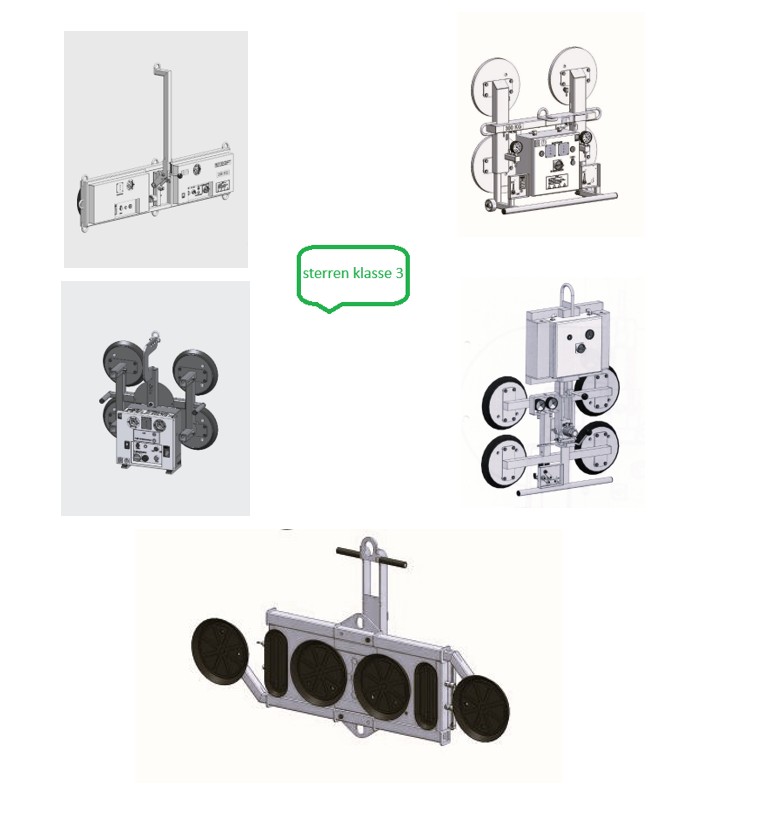
For Model No. 5, our challenge is to design suction lifters that are lightweight and compact, while still having the suction cups distributed over the load and incorporating two pumps, two tanks and two batteries.
Below are some examples of the latest developments:
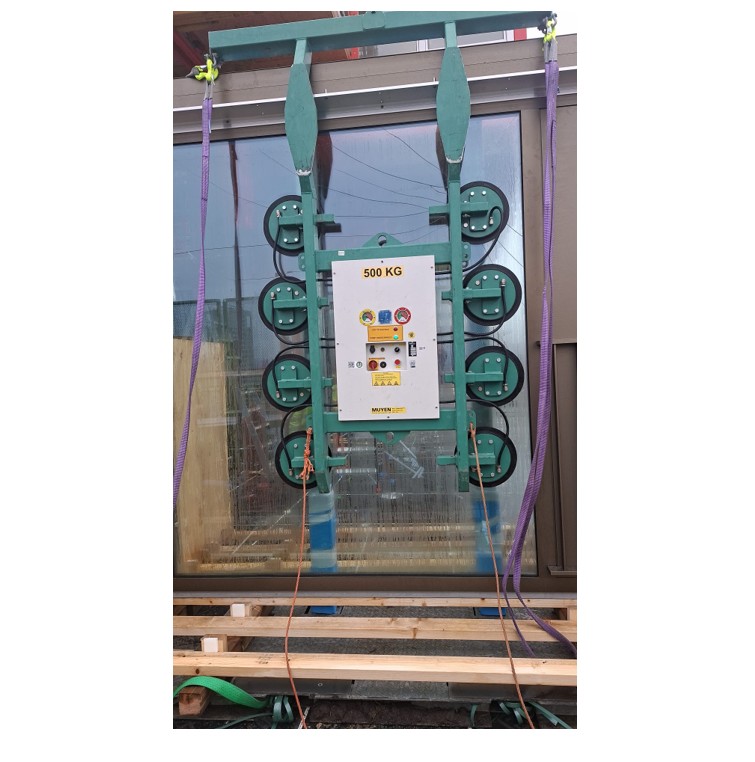
This example shows a glass panel failure in a dual-system suction lifter. The fracture line extends across both systems; the fall protection was the only measure preventing the panel from falling.
Conclusion:
- Specifically, when lifting glass, a dual vacuum system provides a false sense of safety.
- Fall protection and clearing the area are essential and mandatory for all types of suction lifters.
- Use either a single system with a large tank—offering long warning time in case of leakage and no risk of false safety—or a genuine dual vacuum system with suction cups distributed over the load, two pumps, two tanks and two batteries.
Vacuum Lifting Systems for Glass – Summary
| System Type | Components | Advantages | Disadvantages / Risks | Recommended Use |
| 1. Single system | 1 pump, 1 battery, large tank | Compact, high lifting capacity, long warning time in case of leakage, robust components, no false safety | – | ✅ Safe – use for all glass lifting |
| 2. Dual system (small tanks) | 1 pump, 1 battery, 2 small tanks | Compact | Short warning time, fragile electrical components, false sense of safety, glass breakage over two systems | ❌ Not recommended |
| 3. Dual system suction lifter (small tanks, 2 suction cups) | 1 pump, 1 battery, 2 small tanks, 2 suction cups | – | Appears dual but must retain load on failure – unsafe | ❌ Not recommended |
| 4. Dual system (small tanks, suction cups divided) | 1 pump, 1 battery, 2 small tanks, suction cups divided | – | Short warning time, false safety, heavier system, glass breakage over two systems | ❌ Not recommended |
| 5. Genuine dual system | 2 pumps, 2 tanks, 2 batteries, suction cups divided over load | Safest system, all components duplicated | Slightly heavier | ✅ Safe – lightweight, compact design possible |
Key Safety Rules for All Vacuum Lifters for installing Glass:
- Clear the area before lifting.
- Always use fall protection.
- At greater heights, use radio remote control.
- Avoid “dual systems” with small tanks, one battery and one pump (false safety).
- For safe lifting, use Single system with large tank OR Genuine dual system (two pumps, two tanks, two batteries, suction cups divided over the glassplate).
In the words of specialist Astrid de Groot:
“True safety is not defined by standards alone, but by the choices you make every single day on site.”